
A Brief History of Polynesian Tattoo Art
The Art of Polynesian Tattoos
Polynesian tattoos were thought to be the most skilled and intricate to be found in all of the world, by the European explorers from the 17th Century onwards. The beauty and complexity of ancient Polynesian tattoos rival even the master tattoo artists of today. Their art of tattooing had evolved over thousands of years on the Pacific Islands, and was an important part of their culture. Their tattoos used elaborate geometrical designs, with some resembling masks, sea creatures, and other native animals.
Thanks to observations and notations left by earlier anthropologists, scientists and scholars, we are now able to better understand the cultural aspect of the meanings and purposes underpinning Polynesian tattoo art.
The Polynesian Tattooing Process
Polynesian tattoos were originally created using flat, chisel-like instruments, some of which have been found at archaeological dig sites during the 19th and 20th centuries, and the tools have been dated to over 3,000 years ago. The instruments were approximately 4 centimetres in length, and made of pieces of bone that had been filed to a sharp point at one end or even shark’s teeth, forming a series of points, similar in appearance to that of a comb.
These “tattoo combs” were then attached to the end of a long wooden handle, dipped into black colouring made from fire soot and the oil from native nuts and plants, and then placed on the skin. A small mallet was then used to create the tattoo by striking the sharpened instrument into the skin, creating punctures that held the colouring from the ink. This technique of tattooing was painful and it took many hours to complete even some of the smaller designs.
The process of ancient Polynesian tattooing has not been found anywhere else in the world, but it was very common throughout the South Pacific, and it is even used still to this day by traditional tattoo artists in the Pacific Islands.
The practice was first developed and perfected on the islands of Tonga and Samoa, and became the standard for all Polynesian tattooing from that point forward.
Cultural Importance
Tonga
Tattoos were deemed to hold significant social and cultural importance, and islanders were known to have tattoos covering their bodies from the waist to the knees, consisting of geometrical designs that repeated triangles, bands, and areas of solid black. Only priests that had undergone long periods of specialised training were allowed to practice the art of tattooing, and there were strict rituals and rites that had to be followed throughout the tattooing process, by both the artist and the islander that was receiving the tattoo.
Samoa
Tattooing played an important role in religion and warfare, as well as being of culture importance. Tattoo artists held highly privileged positions amongst the Samoan people. The artist typically tattooed men in groups of six or more, and the process was one of ceremony and celebration, with the ritual being attended by their friends and family. A Samoan warrior’s tattoos would begin at his waist and stop just below the knee.
It was the practice in both Tonga and Samoa that women were limited to tattoos only on the lips, ears, hands, and feet. The tattoo designs for women were so delicate and intricate, many of them resembled lace gloves on the hands and beautiful stockings on the legs and feet. The placement of their tattoos were not a matter of ritual or celebration like that of the men, no matter what class they happened to be a part of, even if they were a member of the ruling class.
Maori
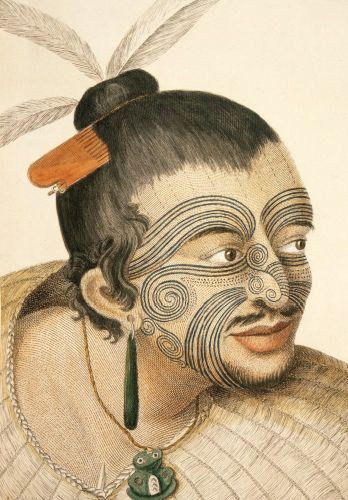
The art of Moko tattooing differed in both designs and tattooing techniques, but also in the fact that the Maoris chose to tattoo much of their face, and the women were tattooed almost as much as the men.
Moko was not only tattooed into the skin with an instrument similar to that which had been observed in other Polynesian cultures, it was also incised into the skin to create scarring in ridges and grooves over the sensitive skin of the face, as well as the rest of the body.
Every Maori male was tattooed on their faces, and most also had tattoos on most of their bodies, as well. The only exception was that of slaves and the most commoners, as they were not deemed fit to wear the designs. Tattooing was seen as an integral part of life by the Maori, and an intricate tattoo on the face was a source of great pride for a warrior, as it not only made him appear fierce to his enemies while in the heat of battle, it was also a mark of attraction to the women of the tribe.
The tattoos of the Maori women were less elaborate than that of the men, but they were no less important. A great show of beauty amongst the Maori women would be lips that were outlined and filled in with tattoos, as well as lines or spirals worn on the cheeks or forehead. Tradition did limit the number of tattoos a woman could have on her face, but unlike other Polynesian women, there were no such limits for the rest of the body, and many Maori women wore elaborate and extensive tattoos on their breasts, thighs, and legs.
Tattoo Designs
Tattoo designs were chosen with great care, and whatever image was chosen was placed on the appropriate part of the body, as each design was meant for specific areas, and every design had a particular name and purpose. Some of the images were of animals, some were of simple geometric shapes. No matter what design was chosen, they were all symmetrical and aligned perfectly with any other tattoos that happened to be already placed on the body.
Tattooing was interwoven into Polynesian culture, and all of their artistic endeavours were related to their supernatural and spiritual beliefs. The decorative themes were also taken from their environment, and were passed down from one generation to the next. Tattoo artists rarely created new designs, instead keeping themselves to the meaningful and varied images that were a part of their heritage.
Many of these designs had significant meanings and purposes, but these were unfortunately lost during the introduction of European life and the disintegration of Polynesian culture. Thanks to the invasion of colonists from Europe, the beautiful and sophisticated art from of tattooing, which had taken thousands of years to develop, was all but destroyed in a matter of a few decades, but has seen a resurgence since the 20th Century.